
Research
Proximity effects in complex oxides at the nanoscale
Oxides exhibit highly unusual properties — magnetism, ferroelectricity, superconductivity, metal–insulator transitions, enhanced photoconductivity and electron transfer — and play a key role in both energy and information technologies.
Our interest lies in the electronic, magnetic, optical and structural properties of materials and devices, and in how those properties change on mesoscopic or nanometre length scales. Proximity effects and external stimuli are the tools that let us tailor these systems.
Experimentally we combine magnetic and transport measurements, structural characterization and local-probe techniques under applied temperature, magnetic field, gate voltage, stress, current and microwave excitation. We collaborate with groups specialised in synchrotron and neutron experiments, ultrafast measurements and Raman spectroscopy.
Research line 01
Tuning quantum properties with size in electron-correlated oxides
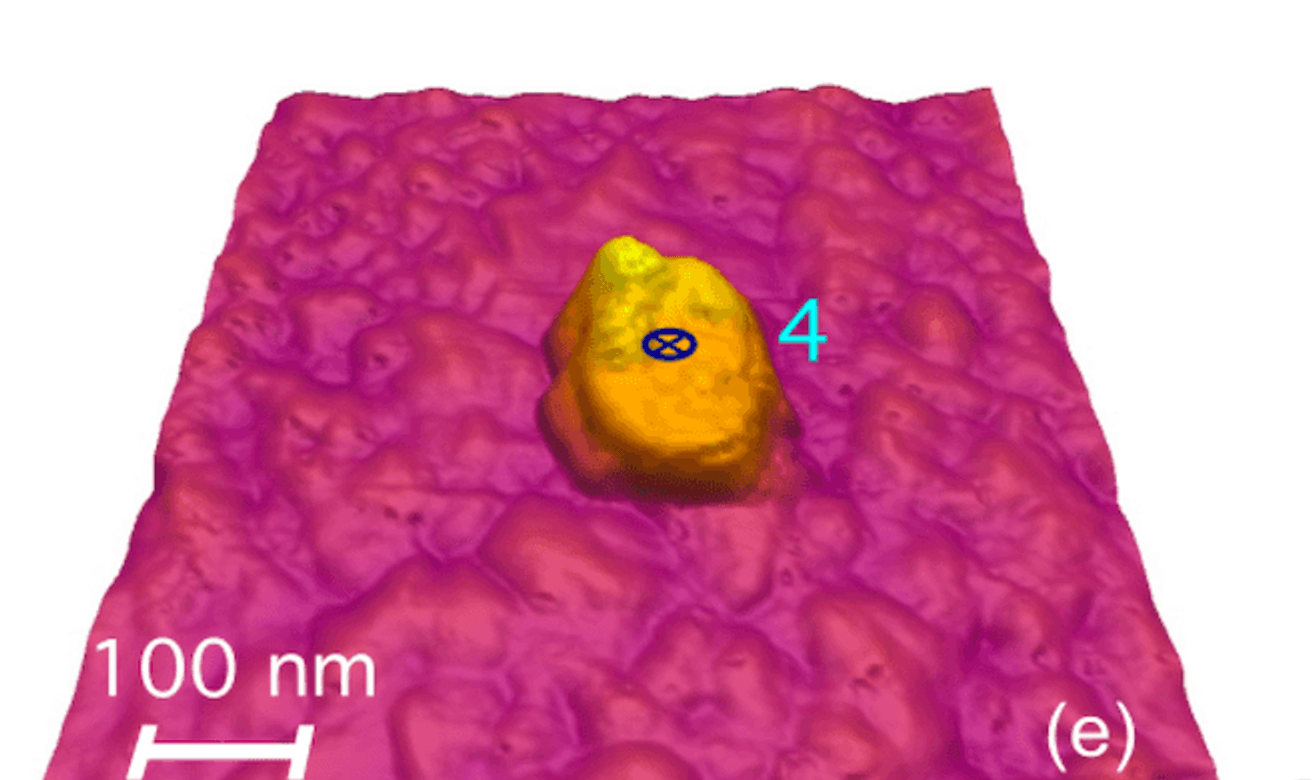
Electron-correlated oxides exhibit a plethora of multifunctional properties that have their root in the complex energy landscape arising from several degrees of freedom. All of these interactions have a characteristic length scale, and therefore one can enhance or diminish them by controlling the sample dimensionality.
We are interested in the resulting effects of confinement at the nanoscale, typically in nanoparticles. As an example, we have proved that ferroelectric BiFeO₃ — an antiferromagnetic material in bulk — becomes ferromagnetic-like at sizes below approximately 60 nm. Interestingly, the ferroelectric properties survive, and therefore BFO nanoparticles are both ferroelectric and ferromagnetic (multiferroic) at room temperature. We are exploring such properties for applications in neuromorphic and quantum computing.
Key references
- Carranza-Celis et al., Control of multiferroic properties in BiFeO₃ nanoparticles, Scientific Reports 9, 3182 (2019)
- E. Ramos et al., Strain-controlled ferromagnetism in BiFeO₃ nanoparticles, J. Phys.: Condens. Matter 32, 185703 (2020)
Research line 02
Neuromorphic computing based on resistive switching
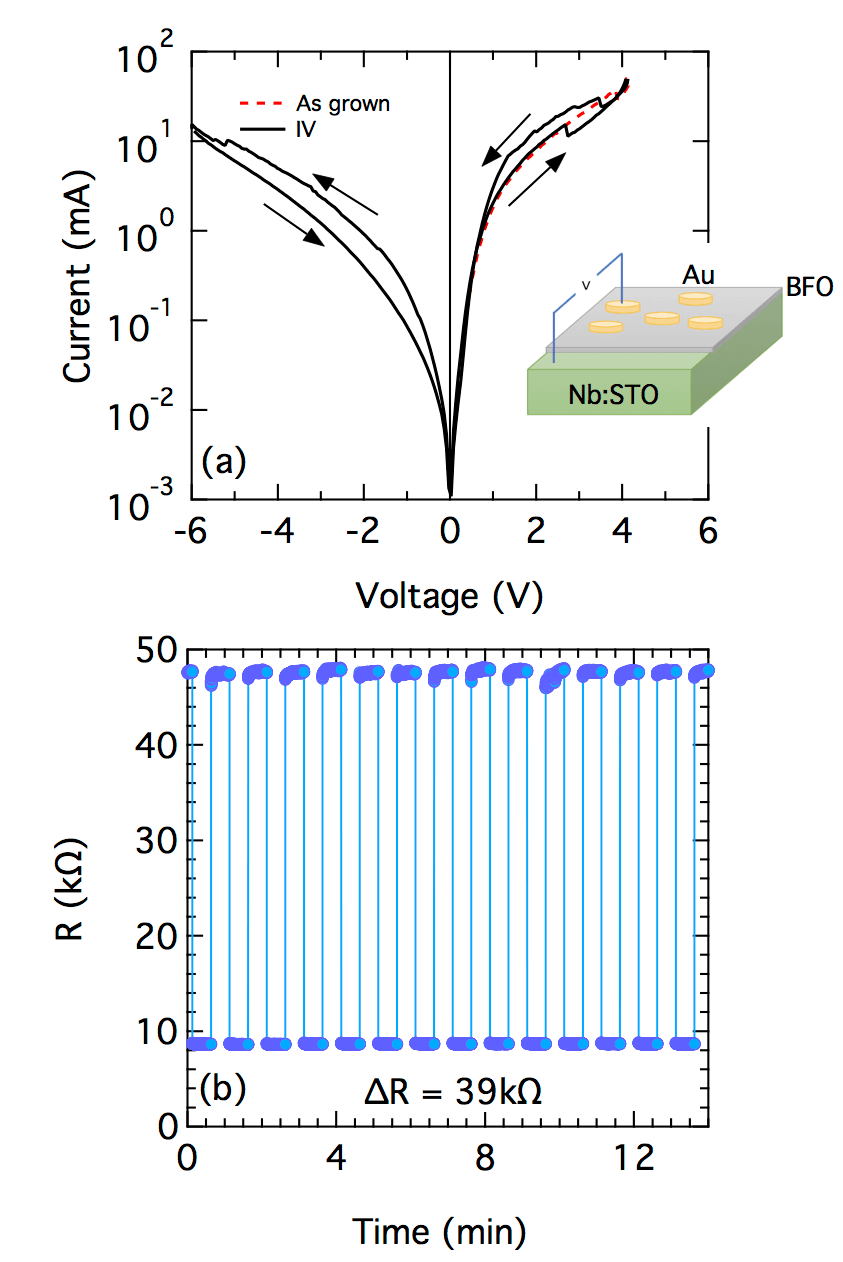
We are interested in novel approaches — devices and properties — that use the multifunctional properties of oxide materials. Resistive switching is at the core of implementations of neuromorphic computing in oxide systems based on transition-metal elements. We are studying materials with multifunctional properties as candidates for future implementations of neuromorphic architectures.
We have also shown that ferroelectric BiFeO₃ thin films present resistive switching phenomena that depend on the electric polarization and the oxygen vacancy content. More systems are being explored in our laboratory.
Key references
- J. del Valle, J. G. Ramírez, M. Rozenberg, I. K. Schuller, Challenges in materials and devices for resistive-switching-based neuromorphic computing, J. Appl. Phys. 124, 211101 (2018)
- A. Cardona et al., Resistive switching in multiferroic BiFeO₃ films: ferroelectricity vs vacancy migration, Solid State Communications 288, 38–42 (2019)
Research line 03
Control of phase transitions by disorder
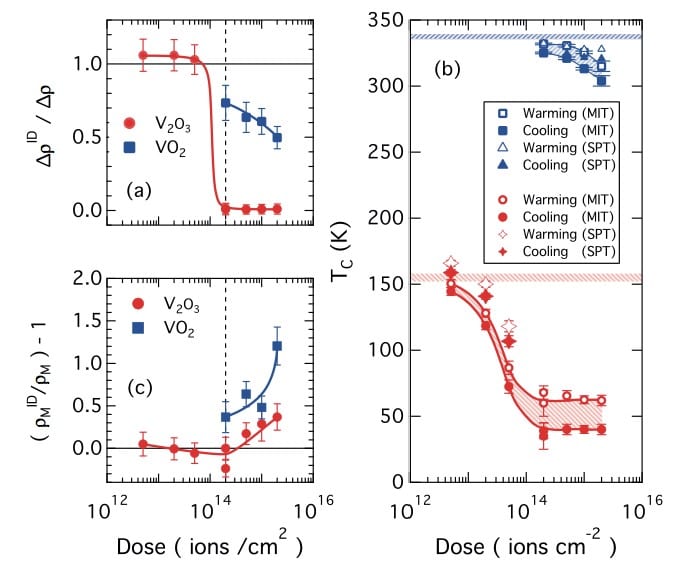
A consequence of a first-order phase transition is phase coexistence across the order parameter. This coexistence imposes a critical length scale onto the system, resulting in critical phenomena such as avalanches. We are interested in the role that defects or disorder play in these systems when introduced at length scales comparable to the phase coexistence.
We have proven that materials undergoing metal–insulator transitions (MITs) respond to defects in a way that reveals their internal correlations. We found that VO₂ is more robust to disorder than V₂O₃ — the disorder being induced by oxygen irradiation at energies low enough to prevent chemical doping, in collaboration with Dr. Javier Villegas at CNRS. The robustness of VO₂ is a consequence of the V–V hybridization that occurs at the transition. Furthermore, we found that V₂O₃ has a disorder threshold below which the MIT is preserved. The existence of a threshold points to a global mechanism responsible for the MIT, as opposed to VO₂, where local effects are crucial.
All of these effects emphasize the importance of disorder in electron-correlated systems. Open questions remain regarding the nanoscale effects of disorder when induced in nano-structured systems. These results suggest similar effects in a plethora of electron-correlated materials, and we propose to look for disorder effects in other complex oxides with first-order phase transitions — manganites, nickelates and other transition-metal oxides. Looking at the response to controlled disorder in these complex oxides will shed light on the trigger mechanisms of their phase transitions.
Key references
- J. G. Ramirez et al., Effect of disorder on the metal-insulator transition of vanadium oxides: local versus global effects, Phys. Rev. B 91, 205123 (2015)
- J. G. Ramirez et al., Ultra-thin filaments revealed by the dielectric response across the metal-insulator transition in VO₂, Appl. Phys. Lett. 102, 063110 (2013)
- J. G. Ramirez, A. Sharoni, Y. Dubi, M. E. Gómez, I. K. Schuller, Phys. Rev. B 79, 235110 (2009)
- A. Sharoni, J. Ramírez, I. K. Schuller, Phys. Rev. Lett. 101, 026404 (2008)
Research line 04
Magnonic control in hybrid materials
We demonstrated that the first-order phase transitions of complex oxides can be used to control the magnetization of ferromagnetic layers in proximity, and that the effects are enhanced when the length scales of the magnetic and structural correlations are of the same order.
We have applied this idea to control collective magnetic excitations — spin waves, or magnons — by enhancing their magnetic damping. Measurements were done at microwave frequencies in a typical electron paramagnetic resonance (EPR) setup. We found that phase coexistence in the oxide layer creates pinning centres that couple ferromagnetic modes to spin waves, causing an increase in the spin-lattice relaxation time. This effect allows us to selectively control the magnetization dynamics by engineering materials with a variable phase-separation length scale.
We propose to extend these studies to nanostructured materials over a wide range of frequencies (1–100 GHz) by employing coplanar waveguides, allowing for devices with damping control and a continuous broad-range variation of frequencies. The laboratory has a vector network analyzer, a microwave sweeper from 1 to 20 GHz, and a test parameter set — instruments that allow the dynamical response of magnetism in hybrid structures to be studied over a broader range of frequencies than an EPR setup permits.
Key references
- J. de la Venta, S. Wang, T. Saerbeck, J. G. Ramirez, I. Valmianski, I. K. Schuller, Appl. Phys. Lett. 104, 062410 (2014)
- J. de la Venta, S. Wang, J. G. Ramirez, I. K. Schuller, Appl. Phys. Lett. 102, 122404 (2013)
- J. G. Ramírez et al., Collective mode splitting in hybrid heterostructures, Phys. Rev. B 93, 214113 (2016)
Research line 05
Magnetism dynamics in complex oxides
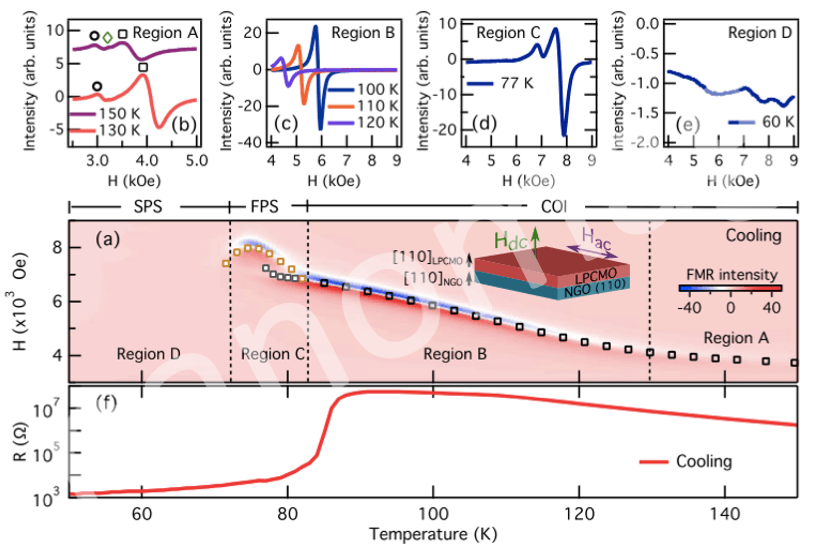
We have recently demonstrated that magnetic percolation controls the magnetism dynamics in LPCMO thin films. This extraordinary behaviour can be attributed to phase coexistence.
Key references
- D. Carranza-Celis, E. Skoropata, A. Biswas, M. R. Fitzsimmons, I. K. Schuller, J. G. Ramirez, Magnetism dynamics driven by phase separation in Pr-doped manganite thin films: a ferromagnetic resonance study, Phys. Rev. Materials 5, 124413 (2021)
- G. B. Gomide, D. Carranza-Celis, G. Kuhl, M. Knobel, J. G. Ramírez, D. Muraca, Voltage-tunable spin resonance in quantum phase-separated material, APL Mater. 13, 041122 (2025)