
Departamento de Física, Facultad de Ciencias · Universidad de los Andes
Quantum materials for computation.
Magnetism, ferroelectricity and phase transitions in confined oxides.
We study Mott insulators, vanadium oxides, multiferroic films, nanoparticles and quantum dots as the physical substrate for neuromorphic and beyond-CMOS computing — using phase transitions, disorder and proximity effects at the nanoscale as the control knobs.
About the laboratory
We work in nanoscience and nanotechnology — more specifically, in novel mechanisms for the control of magnetization at the nanoscale.
We are setting up new sample-growth techniques (sputtering and PLD systems) and advanced characterization methods. The laboratory houses a 14 T superconducting magnet (Oxford), a helium liquefier (Quantum Design), a vibrating sample magnetometer (LakeShore) and multiple electronics stations.
Research lines
What we work on
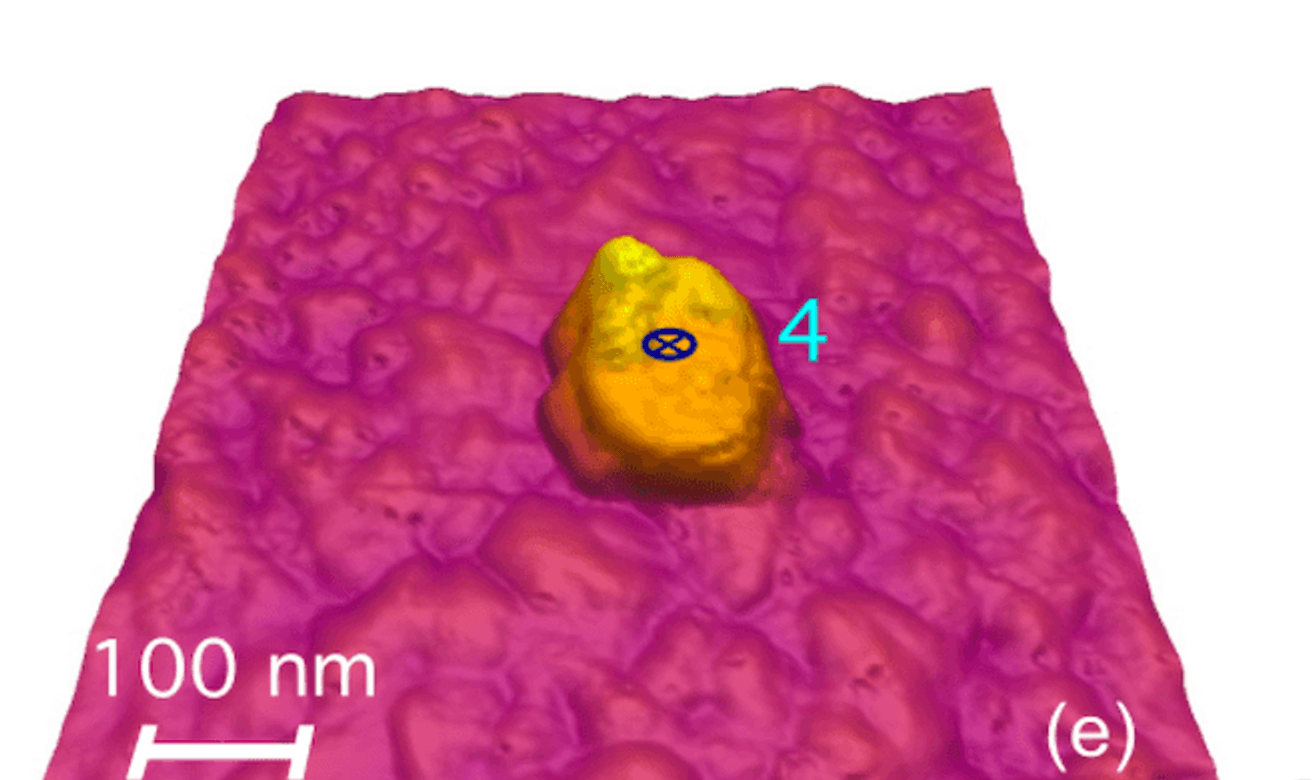
Tuning quantum properties with size in electron-correlated oxides
Confinement at the nanoscale turns antiferromagnetic BiFeO₃ ferromagnetic below ~60 nm while its ferroelectricity survives — a room-temperature multiferroic. Read more →Neuromorphic computing based on resistive switching
Resistive switching in transition-metal oxides as the physical substrate for brain-inspired computing architectures. Read more →Control of phase transitions by disorder
Defects introduced at the scale of phase coexistence reveal whether a metal–insulator transition is driven locally or globally — VO₂ resists disorder, V₂O₃ has a threshold. Read more →Magnonic control in hybrid materials
First-order transitions in an oxide layer create pinning centres that couple ferromagnetic modes to spin waves — a route to selectively controlling magnetic damping. Read more →Magnetism dynamics in complex oxides
Magnetic percolation, not composition, governs the magnetization dynamics of phase-separated LPCMO thin films. Read more →The people
Who does the work
Latest publications
Recent work
- 2026 Guilherme Kühl-Soares, Otavio Canton, Eduardo Granado, Juan Gabriel Ramírez, Diego Carranza-Célis, Marcelo Knobel, Gabriel B. Gomide, Diego Muraca, Local phase reconfiguration induced by laser-driven thermal cycles in a highly-correlated manganite, Commun. Phys., in press (2026). arXiv:2512.05778
- 2026 Ramírez, J. G., Prieto, P., Gómez, M. E., & Schuller, I. K. "Neuromorphic Computing with Quantum Materials: From Mott Insulators to Brain-Inspired Devices". Revista de la Academia Colombiana de Ciencias Exactas, Físicas y Naturales, special issue commemorating ACCEFYN's 90th anniversary, in press (2026). https://doi.org/10.18257/raccefyn.4169
- 2026 Juan Gabriel Ramírez, "Experimental deconvolution of electronic and thermal switching mechanisms in the VO2 Metal-Insulattor Transition", Revista de la Academia Colombiana de Ciencias Exactas, Físicas y Naturales, 50(194):54-68, enero-marzo de 2026. doi: https://doi.org/10.18257/raccefyn.3273, Inaugural article as a Correspondent Member of the Academia Colombiana de Ciencias Exactas, Físicas y Naturales.
- 2025 Vanessa Morales, John Zapata-Rivera, Juan Gabriel Ramirez, Andrea Pastrana-Dávila, Richard D'Vries, Juan-Carlos Castillo, Mario A. Macías, Solvothermal control of crystalline phase and symmetry in Ni(II) pyrazinecarboxylate complexes through in situ amide hydrolysis, Inorganic Chemistry Communications, in press (2025).
Live from the lab
Cryogenics & environment
Read directly from the laboratory sensors. Full history on the lab status page.
So, in the face of overwhelming odds, I'm left with only one option: I'm going to have to science the sh*t out of this.