
News ·
Three students are teaching their own courses
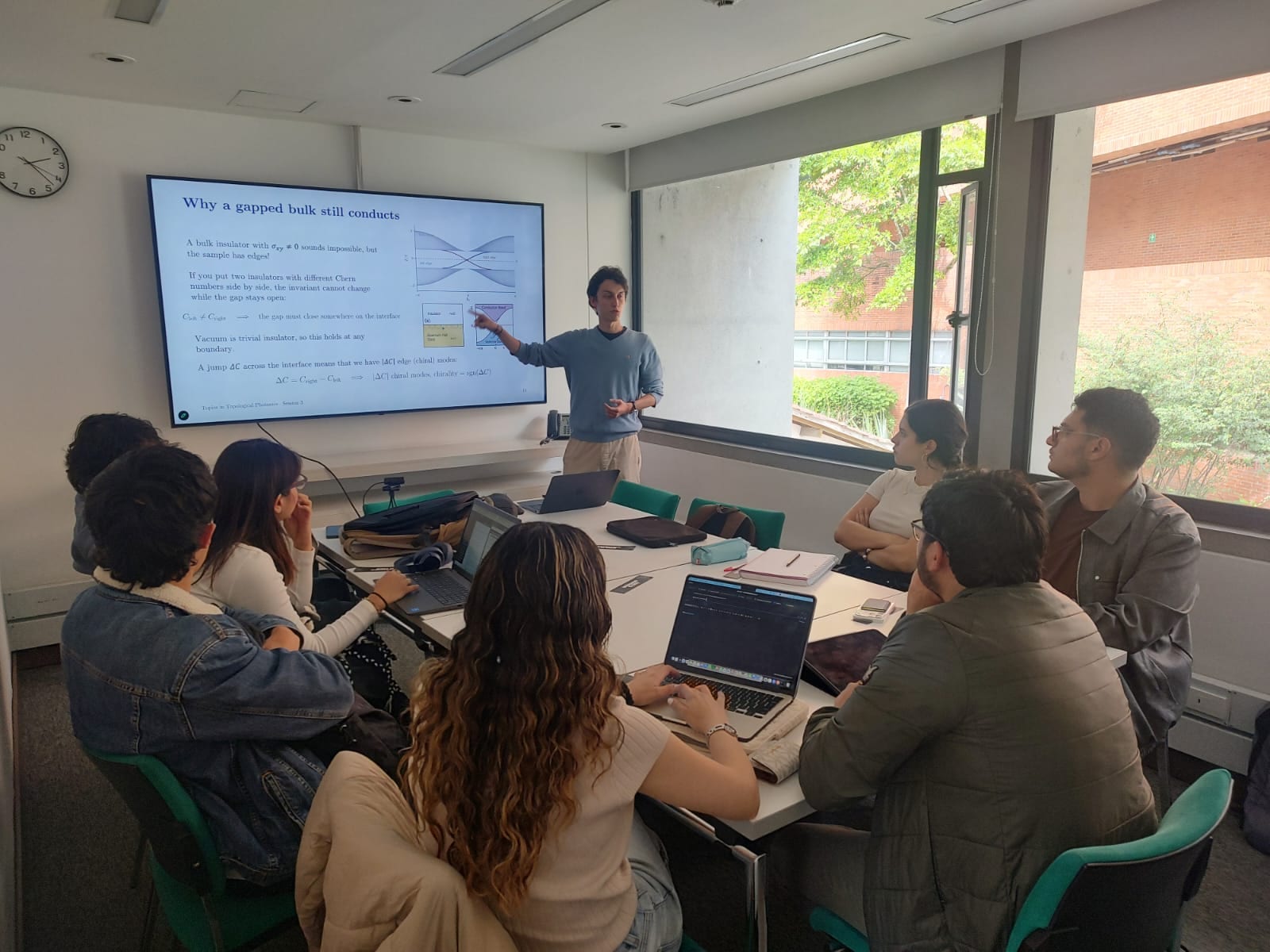
The weekly group meeting has taken on a second job. Three master’s students are running tutorial courses inside it, each on a subject close to their own thesis, and each one is doing the teaching: a thirty-minute lecture per week, prepared, delivered and graded.
The arrangement is deliberate. These are topics the Department does not offer as regular courses, and the fastest way to learn a subject properly is to have to explain it to a room that will ask questions.
Introduction to Neuromorphic Computing
Karla Daniela Chávez Degollado is running sixteen weeks on brain-inspired computing and the materials that might implement it.
The first half is the paradigm: the energy cost of separating memory from processing, integrate-and-fire and Hodgkin–Huxley neurons, spike-timing-dependent plasticity, the memristor and its pinched hysteresis loop, crossbar arrays, and reservoir computing. The second half is the physics — defect chemistry and oxygen vacancies, valence-change memory in HfO₂, Ta₂O₅ and TiO₂, electrochemical metallization, and the Mott transition in VO₂ and NbO₂ acting as a neuristor.
It closes where the field actually lives or dies: endurance, retention, linearity and variability, the figures of merit that decide whether a device is worth anything.
Introduction to Magneto-Optics: Magnon–Photon Interactions
Juan David Rueda Torres is working from magnetization dynamics toward the regime where magnons and photons hybridise.
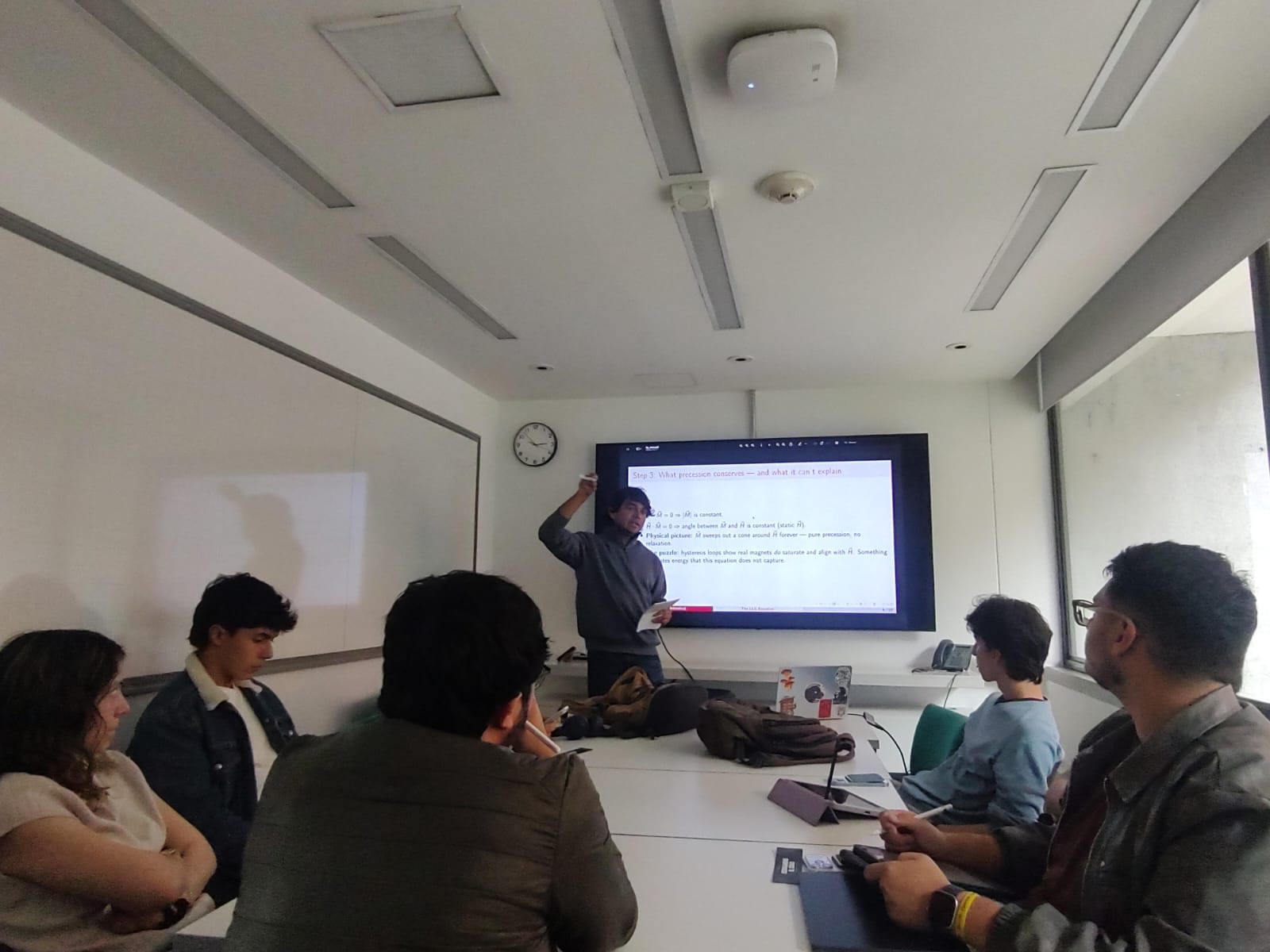
The session above is on what precession conserves — and what it cannot explain. The Landau–Lifshitz equation holds the angle between M and H fixed, so the magnetization sweeps a cone forever and never relaxes. Real magnets saturate and align. Something has to remove energy, and that equation does not contain it.
That gap is the whole reason damping exists, and it is a good place to start a course.
Topics in Topological Photonics
Daniel Santiago Rueda Villalba is carrying topological ideas from electronic systems into photonic ones.
The session in the photograph at the top asks why a gapped bulk still conducts. A bulk insulator with non-zero transverse conductivity sounds impossible until you remember the sample has edges: put two insulators with different Chern numbers side by side and the invariant cannot change while the gap stays open, so the gap must close somewhere on the interface. Vacuum is a trivial insulator, which makes this true at any boundary. The size of the jump fixes how many chiral edge modes appear, and its sign fixes which way they run.
All three run as tutorial courses (FISI 4961) under Prof. Juan Gabriel Ramírez. Outlines are on the teaching page; anyone in the Department is welcome at the seminar.