
News ·
Two undergraduates present at IMRC 2026 in Cancún
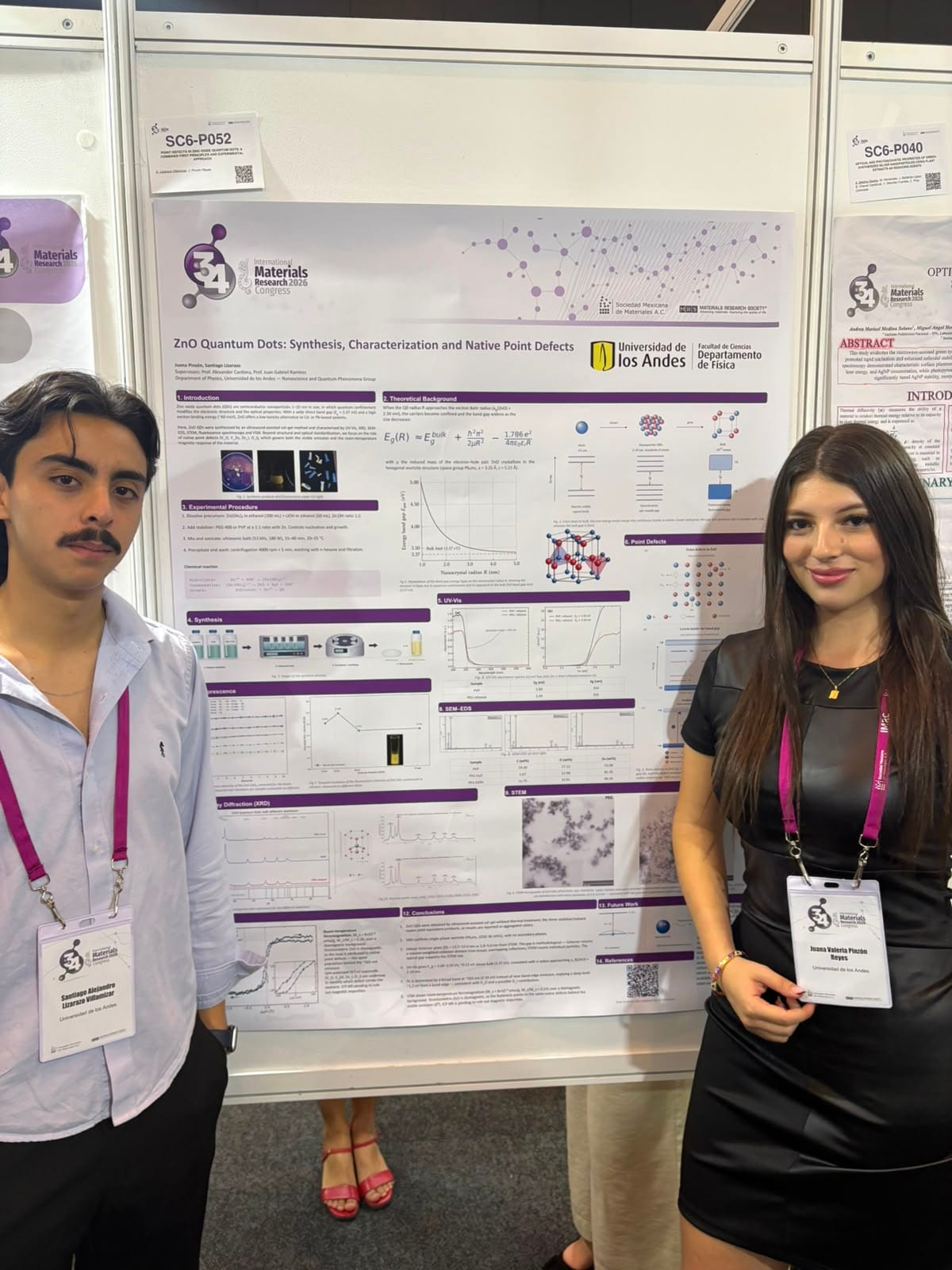
Juana Valeria Pinzón Reyes and Santiago Alejandro Lizarazo Villamizar presented at the 34th International Materials Research Congress, held at the Cancún Center from 16 to 20 August 2026. IMRC is run by the Sociedad Mexicana de Materiales together with the Materials Research Society, and draws around 1,900 participants from some 45 countries.
Both are undergraduates in the group.
ZnO quantum dots: synthesis, characterization and native point defects
Their poster — Point defects in zinc oxide quantum dots: a combined first-principles and experimental approach (SC6-P052) — was supervised by Prof. Alexander Cardona and Prof. Juan Gabriel Ramírez.
Zinc oxide is an attractive host for quantum dots: a wide direct gap and a large exciton binding energy, without the cadmium or lead that most quantum-dot chemistries depend on. Below a few nanometres the particle radius approaches the exciton Bohr radius, the carriers become confined, and the gap opens.
The dots were grown by an ultrasound-assisted sol–gel route with no thermal treatment, then characterized by X-ray diffraction, UV–Vis, photoluminescence, SEM-EDS, STEM and magnetometry. Diffraction shows a single wurtzite phase with no secondary phases.
Two results are worth drawing out. The first is a discrepancy rather than a number: the crystallite size from Scherrer analysis and the particle size counted in STEM do not agree, because the two methods are not measuring the same thing — Scherrer returns a volume-weighted coherent domain from broad, overlapping reflections, while STEM counts individual particles.
The second is magnetic. Stoichiometric ZnO is diamagnetic, yet the samples show a weak room-temperature ferromagnetic response above a diamagnetic background. That points back at the native point defects — oxygen and zinc vacancies — that also sit behind the visible emission. Defects doing two jobs at once is a recurring theme in this group’s work.
The study is part of the TiO₂ and ZnO quantum dots project funded by MinCiencias under the Orquídeas programme.